
Clarity Law
What is a QP9 and why is it important to your charge?
Written by Steven BroughA police court brief or more commonly called a QP9 (Queensland Police Form 9) is a document prepared by the Queensland Police Prosecutions when someone is charged with an offence. The QP9 lists the exact charge with a brief description of the facts which the Police are alleging against you. Depending on what Court your matter is to be heard in and how busy the Police Prosecutions are the document will be provided prior to your Court date or at Court.
It is essential to carefully go over the document prior to entering a plea before the Court, as you are not only pleading guilty to the charge but also to all the facts and circumstances surrounding the charge that the Police allege in the QP9, this may include the way you acted towards the Police, things that you said or admitted or information recorded by the Police that you believe is incorrect or inaccurate etc. This should be remembered when being charged as harsher penalties or less leniency can apply if the document states that you were rude, unruly, unhelpful etc. Also being aggressive when being charged can easily result in a further charge of resisting arrest or obstructing or assaulting police.
Obtaining the QP9 or having a Lawyer obtain the document for you and having a thorough look over the documents before you enter your plea is essential so that if there is any discrepancies they are looked into.
In Court the Police will read out the charge and a brief rundown of their version of events from the QP9. It is then that your Lawyer, or yourself if you are self-represented, can have your say and voice your version of events if they differ to the QP9. If there are significant factors from the QP9 in which you disagree with it may be possible to draft submissions and put them forward to the Police Prosecutions asking them to reconsider the facts alleged or the charge. A Lawyer can advise you on, after going over the QP9, the possibility of making submissions and if so what the likely chances of the Prosecution accepting them would be. It is important to note if what you say is materially different to what the police say in the QP9 then the Magistrate will need to list the matter for a trial or a disputed facts hearing.
In more serious matters, if necessary, it is possible to request a full brief of evidence at the first Court appearance. This document is like a QP9 but much more detailed and will include any witness statements, CCTV or audio footage etc. The Police can take up to 6-8 weeks to produce this material.
Some examples of our success in getting the Police Prosecutions to lower or dismiss charges including:
- Our client had been charged with common assault. Upon receiving and reviewing the QP9 we were able to put submissions to the Police Prosecutions and were successful in having the charge downgraded to public nuisance.
- Our client was charged with stealing as a servant in the sum in excess of $3,000. Upon review of the QP9 and obtaining CCTV footage we were able to have the Police reduce the alleged amount of money stolen to $750, helping the client to avoid jail time.
- Our client was charged with sexual assault. This was successfully downgraded to common assault after submissions to the Police Prosecutions unit.
- Our client was charged with supply of a dangerous drug. After analysing and conferring with the Police Prosecutions we were able to have the charge downgraded to possession of a dangerous drug, which is a much less serious charge.
- Our client was charged with theft, after reviewing the CCTV footage we were able to show the client had paid for the goods and the charge was dropped.
- Our client was charged with Dangerous Driving. After reviewing the dash camera footage we were able to get the charge reduced to careless driving.
Here at Clarity Law we represent clients in Courts across South East Queensland every day, it is this experience, and our expertise that allows us to get the absolute best result for clients by exploring all aspects of their charges and ensuring they do not plead guilty to something they do not need to. We also offer the most competitive prices in Queensland that are all fixed fee so there are no nasty surprises when you receive your invoice. If you want to engage us or just need further information or advice then you can either;
For more information visit our webpage or call 1300 952 255 7am – 7pm seven days a week
Disclaimer – this article contains general advice only and is not intended to be a substitute for legal advice. Its represents information about the law in Queensland and since publishing the law or the interpretation of that law may have changed.
The difference between a conviction and non-conviction
Written by Belinda SmythWhenever someone is charged in a Court it is usual practice that a conviction will be recorded on the person’s criminal or traffic history, depending which one the charge related to.
Once a person is 17 years of age any convictions on their traffic or criminal history will stay on record for up to 10 years. Each State has their own records for what charges occurred in that particular State but they can be provided to other States when requested by a Police force or a Court. You may need a copy of your criminal record to apply for a job, work as a volunteer, work with children, apply for insurance or to get an overseas visa.
Although it can be difficult, it is possible to convince the Magistrates not to record a conviction if there are reasonable grounds to support the request. These need to be good reasons such as –
- You will lose your job due to the nature of your occupation the organisation whom you work for;
- If it is a criminal charge – that you wish to travel or apply for the Navy etc
- It is your first offence
If no conviction is recorded you do not need to disclose to anyone that you have been charged with that offence (except if disclosure is required by law for example applying to work with children). If, for example, an employer does a search a non-conviction will not show up on a criminal history, however, the Police and Courts will always be able to see the charge and the fact that no conviction was recorded.
We have had success in obtaining no convictions recorded, even when they were charged with quite serious offences. Here are some examples –
- A client was charged with a large drug offence and owned a car importing business, bringing in cars from America. A conviction would be restricted his ability to travel to America and also to import vehicles to the Country, resulting in him losing his ability to earn an income and keep his business.
- A client was charged with common assault. Due to the fact that he was a school bus driver the recording of a criminal charge would have meant to he would have lost his job.
- A client from overseas, who is now an Australia Citizen, was charged with a drug charge. A conviction could have prevented him from being able to travel overseas to see his family.
- A young client was in the process of applying to the Army and was charged with drink driving. A conviction could have interfered with this application.
If you are charged with any traffic offence (excluding dangerous driving which is a criminal charge) it will only be recorded on your traffic history the same as a speeding fine would be. It is not recorded on your criminal history. It is generally only criminal history which can effect overseas travel but some countries may require more information from you if you have traffic charges recorded.
Here at Clarity Law we almost every day appear in the Courts with clients, many of which are seeking that no conviction be recorded. It is this experience that allows us to get the absolute best result for clients. Other law firms simply don’t have the experience that we do and don’t know the Magistrates like we do. We also offer the most competitive prices for representation in Queensland click here to see what we will charge.
If you want to engage us or just need further information or advice then call us on 1300 952 255 seven days a week, 7am to 7pm or visit our website at www.claritylaw.com.au

Supplying a Schedule 1 Drug in Queensland
Drug laws in Queensland classify drugs into different schedules. Schedule 1 drugs are the drugs the Government classify as potentially the most harmful, schedule 2 drugs are comparatively less harmful.
What many people don’t understand is that the supply of even a small amount of schedule 1 drugs, even for no money, can have serious consequences for a Defendant.
This article we will look at the drug charge of supplying a schedule 1 drug.
How are drugs classified in Queensland?
Schedule 1 drugs include
- Steroids
- Cocaine
- Heroin
- Meth
- LSD
Schedule 2 drugs include;
- Cannabis
- Methadone
- Ketamine
Which court will hear the supply charge?
While the minor supply of schedule 2 drugs, if the police do not allege a commercial purpose, can be dealt with in the Magistrates Court the supply of any amount of a schedule 1 drug must be dealt with in the District Court.
What is the definition of supply?
It is not necessary that the person who supplied a schedule 1 drug to have made money on the deal. Many of our clients have simply supplied drugs to friends for free or for the repayment of small debts. The definition of supply under the Drugs Misuse Act is very wide. In one particular case our client supplied what he thought were ecstasy tablets but they turned out to contain a mixture of legal chemicals including caffeine. In that case the fact the client supplied the drugs on the basis he thought they were ecstasy was enough to satisfy the definition of supply of a schedule 1 drug.
The word “supply” is broadly defined and means;
- to give, distribute, sell, administer, transport or supply
- any offer to do any of those acts and
- doing or offering to do any act preparatory to, in furtherance of or for the purpose of any those acts.
Some examples of supplying drugs include;
- Offering to supply a drug or organising to get drugs even if no deal takes place
- Supply a substance that you say is a drug or you believe is a drug even though its not
- Buying drugs for a group of friends by pooling money together to buy in bulk
- Offering or actually introducing someone to a drug dealer
Will I have to go to prison for supplying a schedule 1 drug?
We have appeared for many clients charged with this type of offence. Generally if this was the first supply of drugs a person undertook and they have no criminal history (and the drugs were not supplied to a person under 16 nor a mentally impaired person) a Defendant could be looking at probation for a guilty plea.
The requirements for probation are generally;
- report to an authorised corrective services officer (“probation officer) when they require it (generally at least initially weekly)
- must not commit another offence
- must take part in counselling and programs as directed
- not allowed to leave the state without permission
- must notify an authorised officer of any change of address or employment
- requirements to stay clean and undergo drug tests
The court could possibly also add a requirement for community service to the probation order.
If the court imposes a probation order the Court has the discretion whether or not to record a conviction. In all cases we have conducted for similar charges we have had no conviction recorded. The lack of a conviction being recorded means the clients are generally not prevented from travelling overseas and their employment prospects are not restricted.
The police want to talk to me about an allegation of supplying drugs, what do I do?
Do not talk to police without getting immediate advice from an experienced criminal lawyer. You have the right not to give a statement to police and in almost all circumstances this is the best thing to do. We have an article on the right to silence in Queensland
How do I find out more information?
We have a full guide to supplying a dangerous drug in Queensland.
Why should I engage Clarity Law?
Quite frankly we care about getting the right outcome for our clients and helping them through one of the most difficult times in their lives.
In the face of a criminal law charge, selecting the right legal representation is paramount, and Clarity Law offers a unique blend of proficiency and empathy that sets us apart. Our firm is dedicated to providing clarity in the often complex world of criminal law. We believe that every client deserves a clear understanding of their rights and the legal process they're navigating.
Our experienced team of lawyers approaches each case with a commitment to open communication, ensuring you're informed every step of the way. With a proven track record of securing favourable outcomes, we have the expertise to navigate even the most intricate legal challenges.
At Clarity Law, we strive not only to be your staunch advocates but also to provide a supportive, understanding environment during this trying time. Choosing Clarity Law means choosing a team that will tirelessly work to protect your rights and pursue the best possible outcome for your case.
You can read more about our founder, Steven Brough’s, journey to starting Clarity Law by clicking here.
How do I get more information or engage you to act for me?
If you want to engage us or just need further information or advice then you can either;
-
Use our contact form and we will contact you by email or phone at a time that suits you
-
Call us on 1300 952 255 seven days a week, 7am to 7pm
-
Click here to select a time for us to have a free 15 minute telephone conference with you
-
Email This email address is being protected from spambots. You need JavaScript enabled to view it.
-
Send us a message on Facebook Messenger
-
Click the help button at the bottom right and leave us a message
We are a no pressure law firm, we are happy to provide free initial information to assist you. If you want to engage us then great, we will give you a fixed price for our services so you will know with certainty what we will cost. All the money goes into a trust account monitored by the Queensland Law Society and cannot be taken out without your permission.
If you don’t engage us that fine too, at least you will have more information on the charge and its consequences.
Other articles that may be of interest
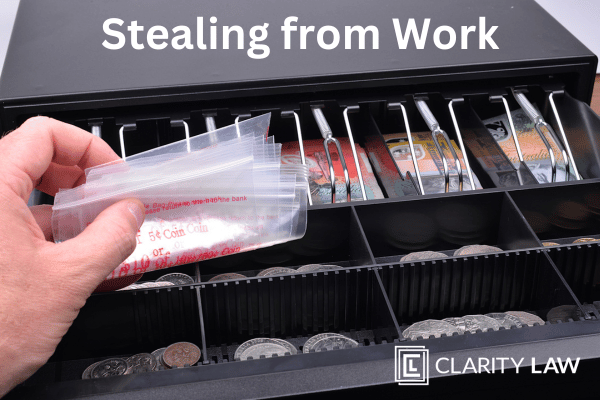
Stealing from work or more correctly stealing as a servant means stealing money or goods through your employment. It is an extremely serious charge and is not dealt with lightly by the courts.
Generally we have found these charges involve the taking of cash directly from the till or taking of stock. The charges with higher amounts usually involved the changing of invoices, the transfer of money from the business bank account or manipulation of the EFTPOS machine.
What does the law say?
The law on stealing as an employee is the following:
Stealing by clerks and servants
If the offender is a clerk or servant, and the thing stolen is the property of the offender’s employer, or came into the possession of the offender on account of the offender’s employer, the offender is liable to imprisonment for 10 years.
What is a servant?
The law refers to clerks and servants. They define this to mean:
any person employed for any purpose as or in the capacity of a clerk or servant, or as a collector of money, although temporarily only, or although employed also by other persons than the person alleged to be the person’s employer, or although employed to pay as well as receive money, and any person employed as or in the capacity of a commission agent for the collection or disbursement of money, or in any similar capacity, although the person has no authority from the person’s employer to receive money or other property on the employer’s account.
Really its just an old school way of saying employee.
What court will hear this charge?
In most cases the Magistrates Court will hear and determine the charge.
If the amount stolen exceeds $30,000 then in some cases the District Court will hear the charge. Whatever the cases the charge will always start out in the Magistrates Court.
What does the prosecutor have to prove?
The prosecutor would need to prove all of the following;
-
The defendant was an employee, clerk or servant
-
The item taken was capable of being stolen
-
The item taken was owned by the employer
-
The item was taken without the consent of the employer
-
The item was taken with fraudulent intent
For more information see our stealing webpage
What defences exist to stealing from work?
A number of possible defences exists including;
-
There was not fraudulent intent in talking the item
-
The person taking the things was not a servant or clerk
-
Mistake of fact
-
The Employer gave consent to take the item
Could the charges be reduced or withdrawn?
It is possible to negotiate with the prosecutor over the charges. This is known as case conferencing and usually occurs once the police prosecutors brief (known as the QP9) is provided to the defendant or their lawyer.
The QP9 will set out what the police prosecutor intends to tell the court happened. This includes the details of the alleged stealing, the amount involved or goods taken and the general circumstances.
It takes an experienced criminal lawyer to advise on the possibility of negotiating the charge with the prosecutor.
What is the likely penalty for stealing from my employer?
The maximum penalty is 10 years if heard in the District Court or 3 years if heard in the Magistrates Court.
Statistics from the courts show that the charge results in imprisonment in 55% of cases. This doesn’t mean all of those people served time in prison as the court can allow a person not to serve time in prison by wholly suspending the sentence or granting an immediate parole release.
Check out our article on sentences of imprisonment which explains more.
In any circumstances where money or goods are obtained deceitfully or fraudulently, whether from an employer, business or an individual client the charge is dealt with harshly and can easily result in a person serving jail time and having a conviction recorded. Stealing as a servant has always tended to result in harsh sentences due to the opportunities for concealment it provides and the betrayal of trust it involves. It will always be more harshly punished than stealing.
When sentencing you the Magistrate or Judge will look at the following to determine the penalty:
-
facts and circumstances including the amount stolen
-
whether the money has been paid back or goods returned
-
the time span over which the stealing was carried out
-
how sophisticated the offending was
-
the defendants criminal history
-
the personal circumstances i.e. financial hardship, mental health issues, remorse etc.
An example of the severity of the nature of this charge can be demonstrated in a Queensland case, R v Jenkins, wherein a man was found guilty of 3 separate charges of theft of less than a total of $3,000 in cash and liquor from his employment over a period of less than 3 months.
His charges were comprised of the following:
Charge 1 - stealing the sum of $170 from his employer
Charge 2 - stealing the sum of $1,995 from his employer
Charge 3 - dishonestly applying to his own use a quantity of liquor belonging to his employer to the value of $765.60 (incl GST).
The total amount being $2,930.60.
The matter was dealt with in the Brisbane District Court and the sentence handed down was 9 months imprisonment for each offence, to be served concurrently and suspended after 3 months (meaning after serving 3 months actual jail time Jenkins was released). In that case the court said
Stealing as a servant has always tended to attract heavier sentences because of the opportunities for concealment it provides and the betrayal of trust it involves
If you are charged with stealing as a servant there are multiple steps we can take to help ensure you receive the best possible outcome. Getting legal advice early however is the key.
See our article on How the court sets a sentence in Queensland for more information.
Can no conviction be recorded even when I stole from work?
When deciding whether to record a conviction the court looks at the following;
- The nature of the offence
- The offenders character and age
- The impact on the offenders
- Economic or social wellbeing; or
- Changes of finding employment
In R v Bryant the stated in regards to regarding a conviction for a stealing as a servant charge;
It is the recording of the conviction that is the applicant's real concern because it may put her at a disadvantage in applying for future employment of this or other kinds. But I consider that prospective employers are entitled to know about such matters and to make up their own minds about the risks involved in employing persons who have committed offences of this kind. It is no part of or function of judges to conceal such information from them.
As you can see getting no conviction is tough, not impossible but very difficult. For more information on what the recording of a conviction means click here
FAQ’s
My employer wants to talk to me about money missing
An admission made to an employer about the nature of a potential crime could be used in a criminal court.
I keep getting calls from co-workers asking what is happening
The police or employer will sometimes use pretext calls trying to get someone to admit to an offence. You should never discuss an alleged offence with any co-worker.
Will I lose my job for stealing?
You will need to speak to an employment lawyer urgently to understand your rights to retain your employment.
My employer has said pay the money back and that’s the end
Paying the money back or returning the goods does not stop the employer from then going to the police to report the alleged stealing.
The police tuned up at my house with a search warrant
The police will often use search warrants to search an accused house to search for evidence especially if it is physical items that is alleged to have been taken.
A conviction will stop me from getting another job
The courts often take the view unless there is good reason then a conviction should be recorded. Only an experienced criminal defence will be able to tell you if it’s possible for no conviction to be recorded.
See our article on recording of a conviction.
The police have contacted me and want to talk about an alleged theft from work?
You should never talk to police without getting legal advice.
For more information see our articles on Declining a police interview and Police questioning and your right to silence in Queensland
Why should I engage Clarity Law?
Quite frankly we care about getting the right outcome for our clients and helping them through one of the most difficult times in their lives.
In the face of a criminal law charge, selecting the right legal representation is paramount, and Clarity Law offers a unique blend of proficiency and empathy that sets us apart. Our firm is dedicated to providing clarity in the often complex world of criminal law. We believe that every client deserves a clear understanding of their rights and the legal process they're navigating.
Our experienced team of lawyers approaches each case with a commitment to open communication, ensuring you're informed every step of the way. With a proven track record of securing favourable outcomes, we have the expertise to navigate even the most intricate legal challenges.
At Clarity Law, we strive not only to be your staunch advocates but also to provide a supportive, understanding environment during this trying time. Choosing Clarity Law means choosing a team that will tirelessly work to protect your rights and pursue the best possible outcome for your case.
You can read more about our founder, Steven Brough’s, journey to starting Clarity Law by clicking here.
What courts do you cover?
We cover all courts in South East Queensland from Southport to Gympie and out to Toowoomba.
We are also a criminal law firm, we don’t do any other type of law so we are in the courts every day helping people with charges like this.
Just some of the courts we appear in for stealing are;
Holland Park Magistrates Court
Maroochydore Magistrates Court
What do you charge?
We charge a flat upfront fee for our services that means no hidden charges or unexpected bills.
Our prices include;
- full preparation for court including checking for defences and devising strategy to minimise penalty
- contacting the police prosecution unit to obtain the QP9 and relevant documents
- drafting submissions for the court
- all telephone calls, emails and meetings with you
- detailed information to you on the likely penalty and information on what will happen at court and afterwards
- appearing in the court with you to conduct your guilty plea
To see what we will for a guilty plea on a stealing charge click here or contact us for a quote.
How do I get more information or engage you to act for me?
If you want to engage us or just need further information or advice then you can either;
-
Use our contact form and we will contact you by email or phone at a time that suits you
-
Call us on 1300 952 255 seven days a week, 7am to 7pm
-
Click here to select a time for us to have a free 15 minute telephone conference with you
-
Email This email address is being protected from spambots. You need JavaScript enabled to view it.
-
Send us a message on Facebook Messenger
-
Click the help button at the bottom right and leave us a message
We are a no pressure law firm, we are happy to provide free initial information to assist you. If you want to engage us then great, we will give you a fixed price for our services so you will know with certainty what we will cost. All the money goes into a trust account monitored by the Queensland Law Society and cannot be taken out without your permission.
If you don’t engage us that fine too, at least you will have more information on the charge and its consequences.
Other articles that may be of interest
Disclaimer – this article contains general advice only and is not intended to be a substitute for legal advice. Its represents information about the law in Queensland and since publishing the law or the interpretation of that law may have changed.
Assault is defined as forceful contact or threatening forceful contact with a person. Depending on the severity of circumstances and injuries will determine the degree of assault you are charged with.
The different types of assault charges in Queensland are as follows, in order of most minor to most severe:
Common Assault
A Common assault is the lowest of the possible assault charges and can come about from anything as minor as a bodily gesture, poking, nudging or touching someone, and even just threatening to do such acts.
Assault occasioning bodily harm
An assault occasioning bodily harm charge occurs when the victim suffers injuries interfering with their health or comfort. Penalties for this charge are increased if there is a statement that the Defendant had a weapon or is in the company of another person.
Assault causing Grievous Bodily Harm
An assault causing grievous bodily harm charge occurs when a person is left permanently injured, scarred or impaired as a result of the assault.
Serious assault (any charge of assaulting a Police officer will automatically come under this charge also)
Serious assault charges occur when the assault is on a person over the age of 60 or is handicapped or dependant on a remedial device. If an assault is on a Police officer is serious it will automatically be placed under this degree of assault. If biting, spitting or any bodily fluid is involved the penalty can be doubled, resulting in a possible maximum penalty of 14 years imprisonment.
Sexual assault
A Sexual assault charge is a result of any unwanted or forced sexual advancement or behaviour towards a person.
When you are charged with any form of assault charge it is extremely important to seek legal representation immediately. Assault charges more than ever are treated very seriously by the courts and can easily result in jail time.
Here at Clarity Law we represent clients in all degrees of assault charges in Courts across South East Queensland every day, it is this experience, and our expertise that allows us to get the absolute best result for clients. We also offer the most competitive prices in Queensland that are all fixed fee so there are no nasty surprises when you receive your invoice. If you want to engage us or just need further information or advice then you can either;
For more information visit our webpage or call 1300 952 255 7am – 7pm seven days a week
Disclaimer – this article contains general advice only and is not intended to be a substitute for legal advice. Its represents information about the law in Queensland and since publishing the law or the interpretation of that law may have changed.

Providing character references to a Queensland magistrate or judge can positively influence the outcome of sentencing. As a seasoned criminal defence lawyer in Queensland,
I aim to simplify the importance of character references, how to obtain them, their content, and their impact on court decisions.
What is a Legal Character Reference?
A legal character reference guides the court about a person's character from someone who can attest to it. The referee should clarify their identity, relationship with the person, reasons for considering them of good character, awareness of charges, and the impact of the offense. References from various connections, including friends and family, can provide valuable insights.
Why Get a Character Reference?
Character references provide information about an individual's character and their response to the offense, assisting the court in determining an appropriate penalty. They offer a holistic perspective beyond the alleged offense, providing positive insights that may counterbalance negative information presented in court.
Do Character References Matter?
Character references can significantly influence the court's decision, particularly in sentencing. However, their impact varies, and some judges may not find them as helpful. It's crucial to consult with your lawyer to gauge whether a reference is advisable based on the judge's preferences.
Who Should Write a Character Reference?
Choose individuals who know you well, such as employers, colleagues, teachers, mentors, or community leaders. Family and friends can also provide character references. Select people who can vouch for your character, integrity, and contributions to the community.
How Should a Character Reference Be Set Out?
A character reference should be formal, professional, addressed to the presiding judge or magistrate, and include the writer's contact details. It should be dated, signed, typed, and printed on letterhead if from a business. Keep it concise, preferably not exceeding two pages.
What Goes Into a Court Character Reference?
Include specific examples of positive qualities, such as honesty, reliability, empathy, and community involvement. Address the writer's relationship with the person, awareness of charges, impact of the offense, and whether the person is likely to re-offend. Remember, referees are not required to attend court.
Main Components of a Court Character Reference
A court character reference to be used in a criminal law matter should include at minimum:
- Reference writer's identity
- How the writer knows the defendant
- Reasons the defendant is of good character
- Acknowledgment of criminal charges
- Impact of the offense on the defendant
- Opinion on the likelihood of re-offending
What Should Not Go in a Character Reference?
Avoid irrelevant or prejudicial information, negative comments about the legal proceedings, alleged victim, or justice system. Never minimize the offense or suggest a penalty.
What to Do Once Given a Character Reference?
Ensure its accuracy and provide a copy to your lawyer for review. Always bring the original reference to the court date.
How Many Character References Should I Get?
Quality matters more than quantity. Aim for 2-4 well-crafted references from credible sources that offer a comprehensive view of your character.
How is a Character Reference Used in Court?
During sentencing, character references are presented to the court as part of the defence’s case, influencing the judge's decision.
Can I Get the Reference Back After Court?
The court typically retains character references, but you can request a copy for your personal records.
Summary
Character references play a crucial role in Queensland criminal courts, offering a tool to present a comprehensive view of the defendant. By selecting and presenting quality references, individuals can enhance their chances of a favourable outcome. Quality and authenticity are paramount in this process.
Click to download court character reference template
Why should I engage Clarity Law?
Quite frankly we care about getting the right outcome for our clients and helping them through one of the most difficult times in their lives.
In the face of a criminal law charge, selecting the right legal representation is paramount, and Clarity Law offers a unique blend of proficiency and empathy that sets us apart. Our firm is dedicated to providing clarity in the often complex world of criminal law. We believe that every client deserves a clear understanding of their rights and the legal process they're navigating.
Our experienced team of lawyers approaches each case with a commitment to open communication, ensuring you're informed every step of the way. With a proven track record of securing favourable outcomes, we have the expertise to navigate even the most intricate legal challenges.
At Clarity Law, we strive not only to be your staunch advocates but also to provide a supportive, understanding environment during this trying time. Choosing Clarity Law means choosing a team that will tirelessly work to protect your rights and pursue the best possible outcome for your case.
You can read more about our founder, Steven Brough’s, journey to starting Clarity Law by clicking here.
How do I get more information or engage you to act for me?
If you want to engage us or just need further information or advice then you can either;
-
Use our contact form and we will contact you by email or phone at a time that suits you
-
Call us on 1300 952 255 seven days a week, 7am to 7pm
-
Click here to select a time for us to have a free 15 minute telephone conference with you
-
Email This email address is being protected from spambots. You need JavaScript enabled to view it.
-
Send us a message on Facebook Messenger
-
Click the help button at the bottom right and leave us a message
We are a no pressure law firm, we are happy to provide free initial information to assist you. If you want to engage us then great, we will give you a fixed price for our services so you will know with certainty what we will cost. All the money goes into a trust account monitored by the Queensland Law Society and cannot be taken out without your permission.
If you don’t engage us that fine too, at least you will have more information on the charge and its consequences.
Other articles that may be of interest
10 reasons to engage us for your criminal charge
Written by Steven BroughRegardless of how serious or minor your charge before the Court is, it is always recommended that you obtain an experienced lawyer to represent you in Court. Whilst the punishment is always decided by the Court a lawyer can influence the Court’s decision on what penalty is handed down to you.
Often our client’s livelihood depends on minimising any penalty imposed by the court.
Here are 10 reasons why you should engage us;
Blog Search
Most Popular
-
 Stealing from Work
Written by Steven BroughStealing from work or more correctly stealing as a servant means stealing money or goods through your employment. It is…
-
 The difference between a conviction and non-conviction
Written by Belinda SmythWhenever someone is charged in a Court it is usual practice that a conviction will be recorded on the person’s…
-
Shoplifting in Queensland
Written by Steven Brough
 Stealing items from a shop (shoplifting) is one of the more common charges Queensland magistrate courts deal with on a… Tags: shopliftingRead more...
-
What is a QP9 and why is it important to your charge?
Written by Steven BroughA police court brief or more commonly called a QP9 (Queensland Police Form 9) is a document prepared by the…Tags: qp9 police brief
-
Centrelink Fraud in Queensland
Written by Steven BroughThere are numerous ways a Centrelink charge can occur such as dishonestly under reporting your income or spousal status, not…